1 Year as a Lazy GM
Announcement: I just released a new solo tabletop game, From Dungeon to Table! You can get a feel for it in about 15 minutes. I encourage you to check it out!
If you've been following this blog for a month or more, you'll probably have noticed that I frequently cite Sly Flourish's resources. I really respect Mike Shea (of Sly Flourish) for his tips and strategies for making roleplaying games enjoyable for everyone at the table.
Just over a year ago I decided to switch my regular D&D prep techniques from megalomaniacal brainstorming to using the Eight Steps of the Lazy GM. This post is a reflection on using the eight steps and how it has interacted with roleplaying games besides D&D, and what twists I've used to make my prep serve my needs.
The key thing to think about: What is the minimum amount of work you do in order to feel prepared to run a game?
This isn't an ad, just a reflection.
Summarizing the Eight Steps
The eight steps are designed to encourage you to spend your session preparation time wisely and to help reinforce your improvisational skills at the table. They work for me, and I've been encouraging new game masters to try them too.
Here are the steps:
- Review the Characters
- Create a Strong Start
- Outline Potential Scenes
- Define Secrets & Clues
- Develop Fantastic Locations
- Outline Important NPCs
- Choose Relevant Monsters
- Select Treasure & Magic Item Rewards
They are pretty self-evident, but you can read the article linked above if you want to find out more about how they work as a method of structuring prep (and improvising during play).
Include the characters in your notes and review them before each game. Focus on starting the game with something excited that hooks your players. Consider what events or situations might take place in your game. Write down some cool things for players to learn and make decisions based on. Describe interesting locations to explore or stumble across. Think about how to roleplay the NPCs the party meets. Write down a list of random encounters or design a special combat encounter. Look for cool loot that would excite the players.
Why I Use Them
I discovered Sly Flourish's YouTube channel in Fall 2024, but I didn't start using the eight steps until Spring 2025. My session prep had already undergone some changes in the Fall, and I thought it was working out okay. Well, it wasn't, and in the winter I decided I needed to try something easier.
Originally, when I first started running games, I would write down exactly what would happen in the game (railroading!) and usually that meant I had way more material than I needed and any choices made were usually superficial (they gave the illusion of independence).
In my second campaign I swapped to just preparing a bunch of stuff each session that may or may not come up. For example, if the PCs were going to visit a library then I wrote up a bunch of random lore they might look into. What about the lore that I didn't think about but they remembered from 8 sessions ago? What about the churro cart that they care a lot more about than my stupid library? Did they care that I had the names for all the librarians? No.
For my third campaign I changed pace from stuff to useful stuff. I did a ton of front-loaded worldbuilding before the campaign began (and used almost none of it) and each session I would spend a few hours coming up with cool stuff to slot in when it made sense. This actually wasn't that bad in terms of gameplay, but it took a really long time to set everything up and that just didn't work for my schedule. Also, it was becoming really stressful to not know if I had enough prepared to run a game, and what about all that stuff I wrote that never got used?
So I turned to the eight steps and they helped me with a few things that I care about:
- My prep only takes an hour per session. I don't spend any longer than that unless I'm uploading assets to Owlbear Rodeo.
- My prep encourages me to improvise where, when, and how things happen rather than sift through notes and second guess myself.
- My prep has stuff for me to draw on if the pacing is getting dull.
- My prep gives me more useful and table-usable information than I think I had with any of my other methods.
I've found that this prep structure helps with my week-to-week campaign notes, and it helps me prepare adventures that I want to release to the public (such as Quest for the Vorpal Sword and Caverns of El). I like to include elements of the eight steps in my adventures to help motivate other GMs improvise and adapt to anything their players might choose to do that I didn't give explicit instructions on (I generally give no explicit instructions, so I imagine this is quite useful).
In general, when getting an adventure ready to be released, I do my normal prep with the eight steps (I usually run the adventure around this time) and then I adapt those notes into something that is easily digestible for other GMs. For example, with Quest for the Vorpal Sword, I had a whole sheet of notes that I condensed into a trifold packet with instructions about how to run a D&D adventure, how to set up a time limit, and how each piece of the Vorpal Sword changes the overall quality of the weapon forged. This isn't stuff I'd usually put in my prep notes, since I have an idea of how they work in my mind already. I only need to write down what I won't remember during the session. For published adventures, I think it's very important to separate out a series of clues and/or treasures that the GM can distribute throughout a session as they see fit. This way, all the information is presented upfront to the GM in an easily digestible way (bullet points of history, motivations, lore, etc.) and they can churn it into weird things the PCs interact with (i.e., a cracked mural of a many-pointed star labeled as 'Hekattan' in blood ink).
What Does My Prep Look Like Now?
I still use the eight steps, and I mostly stick to the outlined structure when I do my prep, but I also make changes based on the games I'm running.
- I run a lot of single session adventures, so I don't need to Review the Characters as often as I might in a longer campaign.
- Scenes are a good step for managing pacing, so I use them to block out the start and end of each adventure (what calls the players to action & what threatens them from completing the job). I usually add the Strong Start as the first or second Scene. For campaigns, it's harder for me to come up with a good Strong Start since we always end and start in different places. Sometimes something weird happening can work well, other times I have to think really hard about a call to action to draw folks in.
- It's nice to have Secrets & Clues, and I usually make more than I would reasonably need. It's easiest for me to come up with things to learn beforehand than to make them up on the spot.
- I'm still trying to figure out what I need to describe an interesting Location. Right now it's vibes + room/place names and then I improvise the rest. It works. Dunno how I'll improve it yet.
- On the other hand, I rarely need much to run an NPC for my games. A name is good enough to go on for an entire session, sometimes even longer than that. Having notes for what kind of voice the NPC uses is nice though, since I like to do that.
- Monsters come up less frequently for me than they might in someone else's game. I don't really enjoy combat as much as good conversations between players, so a couple monsters to drop in when the tension gets really bad is nice.
- I don't always need random Treasure so much as an explicit Reward to give players for completing a mission.
For my campaigns, I usually used all eight steps together. They worked really, really well for D&D 2024, the Trespasser RPG, and a sandbox FIST game. In my ongoing UVG game, having a structure prep technique makes it possible for me to actually run the game. Without any scaffolding I would probably lose my mind trying to parse information from those psychedelic pages.
Using them with one shots and single session adventures typically has me cutting out Reviewing the Characters. Instead, I focus on taking really good notes when everyone builds or introduces their character so that I can factor their decisions into the game. Things that you want to pay attention to are: factions the PC is tied to, any role they wish to play in the adventure (cultist, mastermind, epic hero, etc.), and any weird trinkets or abilities they have (neuromancy, an abacus, etc.).
The Six Steps of Mythic Bastionland
I love Mythic Bastionland (MB), as you may know, so it gets to be the big example.
I found that when running MB I only needed five of the original eight steps, and I added my own extra sixth step. Fun fact: my prep usually took less than 30 minutes with this game!
- Review the Characters remained useful (How much glory does everyone have? What Knight are they? What season/age actions have they taken? What allies or enemies have they made?)
- Myths was a new step! (I tracked all six Myths in the Realm with a numbered list for easy randomization. What is their nearest Holding? How many omens have we seen?)
- Secrets & Clues are always useful (Each Myth got at least one secret or clue about it, usually just a hint about the next omen to come up.)
- NPCs kept coming up (I usually just pulled the Cast from each Myth into this section, and I added any characters the party knew in nearby Holdings. Seers also showed up here.)
- Monsters were similarly useful (Same as the NPCs, I just grabbed these from the Myths. Sometimes I added something weird to encounter in an empty hex.)
- Treasure sometimes showed up (There isn't much loot in the Myths, so I wanted at least one interesting trinket ready if the party visited an empty hex or cool landmark.)
Scenes and Fantastic Locations didn't really make sense to have in my notes. Scenes are taken care of entirely by the Exploration Procedure and Myth omens built into MB, and Fantastic Locations are only necessary when I know the party is heading into a more detailed location (of which there are very few; an example is in my notes below). Also, most of the "Fantastic Location" step is taken care of by the Realm Creation process before you start a game.
I prefer to interpret most Myth omens at the table rather than expanding them into something beforehand. I find that when I focus on improvising, the game sessions play far better for my tables. I think this is because each omen is quicker when you take the first interpretation that comes to mind and run with that. There are times when you understand a myth so well that you can interweave the omens even better than the book offers, but I also like the mysticism of finding something that makes very little sense when you first encounter it (why are these frogs making noises and giving us weird dreams? Does it really matter?).
You'll notice I don't mention the Strong Start step - that's because it's also taken care of by the Exploration Procedure by forcing players to make a bunch of decisions about where they go at the start of the game.
Here is an example of what my notes for MB looked like last summer:
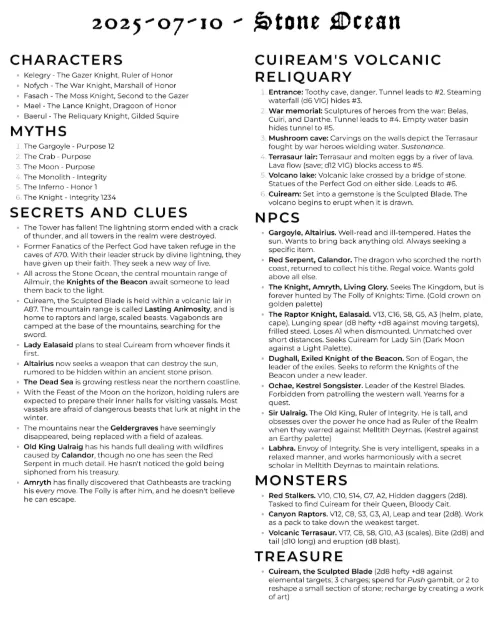
You may notice some of these Myths aren't in the original book! These are from my free supplement Myths Abound!
Final Thoughts
Over the last year I've run about 15 different systems with the eight steps as my preparation structure. They worked for all of them. Admittedly, the systems aren't really that different from each other. It's not like I'm playing Public Access, Troika!, Lancer, Blades in the Dark, and CAIN all at once. The eight steps work really well for dragon adventure games like D&D and the situational heists, mysteries, or infiltrations that you find in games like FIST.
I think that as I continue to expand my collection of roleplaying games, and continue to run them, I'll get a better understanding of the true breadth of use of these eight steps. I can't wait to find out!
Things on my radar:
- I loved reading this Mork Borg Duo supplement, particularly for the section on making your own cult!
- I played a round of Blacktail Harbor solo and had a good time journaling about a very random and sporadic mystery. My character died, but they sort of saved the day.
- This Vampire Survivors-style game called Loki's Revenge is a great homage to the genre!