Exploration in Mythic Bastionland
As written, the exploration procedure in Mythic Bastionland is simple enough when running the game. However, I've seen a lot of chatter online about how we might expand the possible things you might encounter instead of Myth Omens or Landmarks, as well as what to do with those Myth Omens when you do get them. In this post, I'll address both topics with some advice I've gathered by playing this game for the past two years.
If you're super comfortable with Mythic Bastionland already, you may still be interested in reading "Okay, But I Didn't Roll a Myth".
Basic Exploration
Before we begin, the exploration procedure in Mythic Bastionland (henceforth MB) is as follows:
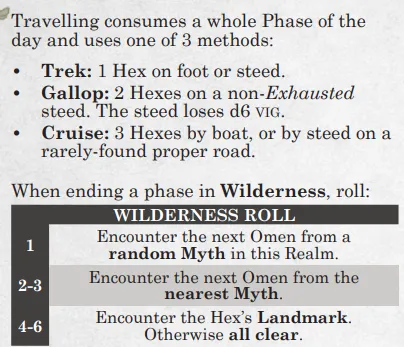
(Travel, Mythic Bastionland, p. 18)
There are three Phases in a day, and Knights are usually sleeping for one of them. Knights typically travel two to four hexes per day across a realm-wide hex map.
Players may or may not be given a map of the realm beforehand, depending on how you decide to run the game (I personally prefer a hand-drawn sketch of the realm, rather than handing my players a hex map). It's the players duty to keep track of which hex they think they're in (using an empty or full hex map, as above).
Each Myth has 6 Omens which are encountered via the Wilderness Roll or whenever the Myth's "home hex" is visited. Each realm has 6 Myths spread randomly across its hexes.
Across the entire realm there are probably around 18 to 24 landmarks, maybe more. They include dwellings, monuments, ruins, hazards, curses, and sanctums. Some are more dangerous than others.
You, the GM, will design the realm before you play the game. The rules in the book make the process quite exciting, though it's definitely time-consuming. I think when I make a realm from scratch it usually takes me two to three hours to get it all prepared. You might also use someone else's pre-created realms, such as Sindraline or the Jotunrift. These usually have more content than you would generate on your own using the book.
Rolling a Myth
So your Wilderness Roll, which you make every Phase of the day, comes up as a 1, 2, or 3, that means you get to run a Myth Omen! In the book, each Omen is a couple sentences long and describes a small situation or scene that takes place before the characters. Often there are opportunities for characters to interact with the environment or cast of NPCs, and maybe about 50% of the time they'll get into a combat.
In general, you should be focusing on the Primacy of Action (described on page 16) that states "past action taken by the players supersedes content generated by prompts or rules." This means that regardless of the Omen you roll, you should think about the fiction first and consider how previous actions taken by players might change what the Omen actually is. You are encouraged to modify what is written into what might happen if nothing is done to stop it.
Additionally, Myth Omens do not have to make sense. That's a part of what makes this game fun! Myths are weird and crazy and might take you to strange places. Some omens might take place entirely in a dream or across the realm from where you thought you were. You might never know exactly which omens are related to each other unless there is a strong through-line between them (which can create a useful discrepancy between player knowledge and GM knowledge).
If the players kill a sculptor because he was carving a statue and lamenting immortality, then maybe the arrival of the Colossus during a later omen shows them that the sculptor had bestowed a curse on the statue, awakening it to attack the realm. If, instead, the characters befriend the Colossus, perhaps the final omen is the Colossus waving as it walks off into the sunset instead of just collapsing against a mountain.
Running Myth Omens can seem daunting at first, but there are several strategies you can adopt depending on your comfort-level with the Myth:
High Comfort
You are really confident and excited to improvise based on what you understand about the realm.
In this case, you don't need to do any additional prep other than having spark tables at the ready for when you need them. Read the omen, describe the scene to your players, and play to find out what happens.
Medium Comfort
You aren't confident that you can improvise a good scene from just the little scraps found in each omen entry.
In this case, consider reading through a few of the omens for each myth in your realm before the session and jotting notes about how you can further develop their related scenes if they come up during the game. Patchwork Paladin has a useful post for writing these notes!
Low Comfort
You don't like the omen entries for a given myth, but think you can scrap something cool together anyway.
In this case, you're basically going to re-write the myth using your own common sense and ideas. This isn't too hard, you just need a series of six escalating scenes that offer choices to your players. They don't need to be obvious choices.
No Comfort
You don't like the myth at all.
In this case, you don't need to use it! Just roll up a new myth and see if it works for you. There's 72 myths in the book, and even more created by other people (I made 24 new Myths!), which means you have plenty to work with.
Okay, But I Didn't Roll a Myth
Yep, this will happen when you roll a 4, 5, or 6 on the Wilderness Roll. There are two scenarios:
Landmark Hex
This hex has a cool landmark that you can describe and the players can interact with. The realm creation procedure should prepare you well for these landmarks, so don't feel like they need to be complex, interdimensional hotels rising up out of a volcano. They can just be a potter's hut on the edge of a forest. Everyone loves a nice potter who can tell them about the nearest myth.
If you really want to spruce up your landmarks, you can follow the Site Creation guidelines on page 15 to create a more in-depth exploratory location. I generally don't do this, instead I save Sites for when I need a dungeon of some kind that holds a powerful relic of the realm.
No Landmark, Boring!
Sometimes empty hexes are nice, but you may decide that it would be cool to throw a red herring at the players. This means you are generating a scene that could feasibly be a myth omen, but actually isn't. It kind of throws the scent off the trail while still creating a memorable situation for players to engage with.
Here's a simple mechanism for creating these "fake omens" or otherwise weird and interesting scenes that could prompt player interaction:
Rolling a 4 on the Wilderness Roll
Use the Nature spark table (page 22) to generate some interesting Flora to cover a section of this hex. Have the Flora be near some kind of Feature too. When and if the players take a moment to study the Flora, use a Wonder "Theme" to generate an effect of the Flora.
Example: Aromatic Grasses near a Buried Brook that bring Pleasure and recall good memories when inhaled.
Rolling a 5 on the Wilderness Roll
As above, but this time generate some interesting Fauna near a Feature, and make the Fauna made out of a Wonder "Element".
Example: Watchful Ungulates (large hooved animals, let's imagine a hippo) grazing near a Colourful Seat naturally formed from a clay hill, and all the ungulates are made of Beasts (let's imagine the big hippos are actually made of many tiny hippos).
Rolling a 6 on the Wilderness Roll
It's time for a wandering person! Roll another d6: 1-2, it's a Vassal | 3-4, it's a Vagabond | 5-6, it's a Knight. You can read about what these three types of people know on page 19 of the core rules. These people are encountered near an interesting Feature and right as you meet them, the Sky changes its "Tone" (just keep using those Nature sparks!).
Example: You spot a bard (Vagabond) hiding in plain sight behind a Spiked Monolith. As you approach them, the sun passes partly behind a mountain, covering the sky in a Bloody wash. The bard won't stop twitching as they ask the directions to the nearest ruler's keep.
Any Vassals come from the nearest Holding or Dwelling and are caught returning home after running an errand nearby (gathering food, talking to a friend, escaping danger, doing trade, etc.).
Any Vagabonds come from far away and are either looking for trouble or running from it. They won't challenge the players, unless you think they should, and instead inquire (suspiciously) about where they can find riches (probably phrased as "nearest dwelling") and/or a place of safety.
Any Knights come from the nearest Holding, serving it's ruler on their court. They have been sent on a mission to receive guidance for the court from the nearest Seer, and would like directions from the players.
Final Thoughts
We went over how you might play through a Myth Omen when you roll one for the Wilderness Roll, as well as how you can spruce up the action after rolling a 4-6 in an otherwise empty hex.
I usually like to add extra details when the party has encountered two or three empty hexes in a row, that way I can keep the excitement and curiosity high. However, there are times when the party has a very specific goal in mind where I won't mess with them during empty hexes in order to save time and help them reach their destination in a timely manner.
These tools are all about helping you manage how much you need to improvise in a given session, how much you feel like prepping beforehand, and what you can do if the game feels too stale and/or predictable.
Things on my radar:
- Dreaming Dragonslayer created a Mythic Bastionland Syllabus a while ago. You should check it out if you want to see what a subset of people are saying about the game!
- I watched Obsession and Backrooms at a theater this week! They are both worth watching if you like scary movies: 8/10.
- Obsession was less scary, kind of like if you reversed Barbarian to be scary at the end and not the beginning.
- Backrooms was very scary. I think it's because of the way they did the camera recordings to make it really feel like you could be in the same position as the characters.
- I might be biased because this was my first time actually going to the movies for a horror movie, so the surround sound really hit different.
- There are some really big Humble Bundle deals on ttrpgs right now, check them out if you haven't seen them yet!
- Tavern Lore made a solo dungeon toolkit for Gloam. You could, of course, use it for any roleplaying game.