System Agnostic Omens
Omens are the primary "adventure seeds" used by Mythic Bastionland. I've talked about how to actually use them during the Exploration Procedure of the game, but I'd also like to address their utility in general for other roleplaying games.
What are Omens?
Omens are individual fragments of an overarching situation resolving somewhere in the game world. I like to think of them as short scenes that could play out almost anywhere in the world, regardless of where the party is traveling or what their current goals are.
For me, Omens just need to be a spark of an idea that gets me inspired about something: an old merchant rolling a wagon and collecting teeth from passersby. Maybe I have stats for the merchant in case the party decides he needs to die, and maybe I wrote down why the merchant likes collecting teeth. In general though, Omens can be as short as you require them to be in order to keep them useful.
There are generally 6 Omens to a given Myth in Mythic Bastionland. I think this leads to a relatively satisfying duration of the situation, but I don't see why there can't be Myths with 3 Omens or 9 Omens too (or even more, if you want to duplicate the City Quest).
Omens are loosely, or tightly, linked to an overarching theme, obstacle, monster, or item somewhere in the game world. They resolve sequentially and you have the liberty to modify future Omens based on the methods used by the party to resolve or otherwise interact with previous Omens. In fact, should the party find a way to "solve the problem" of the Myth before the 6th Omen, you are allowed to call the whole adventure complete.
Sometimes the problem doesn't get solved. In which case, you are invited to extrapolate beyond the original theme, obstacle, monster, or item and make a decision about how the game world changes based on the party's actions (or lack thereof). This could mean a tsunami floods the low lands of your map, or a wicked tyrant takes over the largest settlement, or a bunch of interesting people go missing, or any number of other things.
As you might be able to tell by now, Omens aren't really specific to Mythic Bastionland. They just go by other names in other roleplaying games. The name I like to use is pretty simple: adventures with consequences.
Recall: The Wilderness Roll
We saw this in the previous Mythic Bastionland post, but I'll repeat it here for those who don't remember:
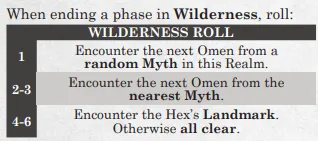
(Travel, Mythic Bastionland, p. 18, Chris McDowall)
Every time the party travels somewhere, we see what they find: an omen of a nearby Myth or a notable Landmark of the surrounding area.
You might notice now that this is just like a random encounter table. You have a 50% chance to encounter something, with the odds stacked slightly against you for how often that something is a monster that wants to hurt you (or vice versa).
You also have a 50% chance of finding a cool monument or location nearby. I haven't played too many games that are designed so that there is a chance you don't find those cool landmarks, but I think it works for a game built around exploring the realm frequently.
For other roleplaying games, we don't always know what to describe for a landmark (maybe there isn't anything interesting on our map). In these cases, I find random tables are my friends.
Creating a monument to place in front of the party, regardless of where they are, can often lead to great collaborative worldbuilding, excitement about drawing on the map, and curiosity from those players who want to poke and prod and search for treasure.
Expanding to Other Systems
Okay, so we looked at what Omens are and how we encounter them, but what about actually using these ideas in other games?
You need adventures with consequences for your party to be faced with. They can choose whether or not to seek these adventures out on purpose, or they can encounter them in the wild as they progress other goals. What do you need for these adventures?
- Create an adventure location with a situation
- Example: Kobolds in a cave want to serve a dragon who lives in the same mountain. The dragon is greedy.
- Make a list of progressively worse things to happen if nothing is done about the adventure location's situation.
- Example: Some kobolds stumble around looking for trouble -> A dragon is seen flying overhead -> Miners are attacked by groups of kobolds -> Kobolds with dragon-scale armor threaten a nearby village -> The dragon descends to claim a greater territory, an army of kobolds eager to obey
- Plop the adventure location somewhere on the map. Whenever the group visits this location, they will have opportunities to resolve the situation.
- Example: Convince the kobolds to rise against the dragon. Ask the kobolds to please stop harassing miners. Offer bushels of gemstones a peace treaty. Eliminate all the kobolds in the cave. Make a deal with the dragon.
- After you have 4, 6, 8, or 10 of these locations, make a table to roll on whenever the party travels somewhere. When you roll a location's entry, progress to the next "bad thing" and have it happen right where the party is so they can do something about it.
- Example: 1, The Kobolds | 2, The Fairies | 3, The Rats | 4, The Goblins
How different is this method of situation-omen-adventure prep to what you might do normally? I don't know, I can't read your prep notes, but I bet it isn't significantly different! Most GMs think about what their villains are doing when the party isn't doing anything to mess with them, most GMs also develop adventure locations with things for the party to do there.
With this method, you'll be able to quickly set up a situation that gets worse over time, creating a sense of urgency for the party to find an efficient way to solve each problem before it becomes really bad.
Final Thoughts
We looked at Omens in Mythic Bastionland and considered their purpose, their uses, and ways to use them in other game systems. In reality, Omens aren't much different from typical adventure hooks and random encounters, but they often provide a progressive structure that isn't always present in other games.
I encourage you to think about how you show villainous progress to your players, and consider if there are more ways you can up the ante with random encounters.
That's all for this week!
Things on my radar:
- Sheep Detectives was fine, 5/10.
- New short D&D adventure coming soon (likely to be released next Friday)! It'll will be a "sequel" to Quest for the Vorpal Sword.
- Murkdice has written about sequential encounter tables using Omens as one inspiration.
- There is a colossal Free RPG Day Bundle on RPGTrader. Please check it out!
- Chris Vicari has an interesting article on the Psychology of Choice in D&D Prep. I especially agree that "The more you understand your players, the easier it becomes to guess what they’ll do. The relationship gets sharper over time, and your craft sharpens with it." This concept of orienting the content of your prep towards what your players enjoy seems simple and obvious, and yet it works wonders for engagement at the table!